
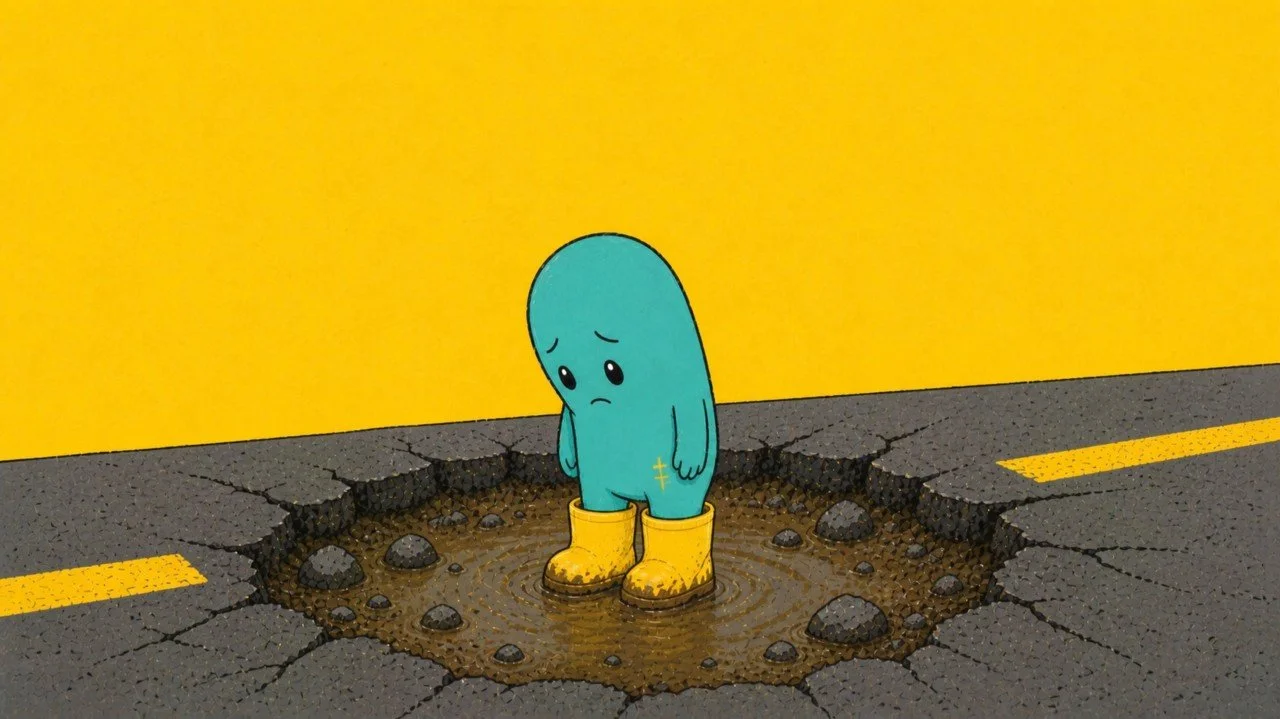
Are you stuck in the pothole of worry?
There’s a mix of exhaustion and excitement that makes it harder to find momentum—especially when you genuinely don’t know what’s around the corner.
We’re caught between AI overload and disruption on one side, and AI possibility and problem-solving on the other. Both are real. And the tension creates a familiar cocktail: urgency + paralysis.
It can feel like you’re standing in a pothole you can’t get out of.
When we’re stressed, we lose our capacity for strategic thinking. We can’t hold the long view. So we fix what’s right in front of us—the pothole we’re standing in—because it’s concrete. At least it feels like doing something.
But fixing the pothole you’re in isn’t always the same as moving forward.
It’s the difference between repair and direction. Between staying busy and building momentum.
Excitement can drive us forward—but only when it’s driven by what we care about. If it’s powered by fear of falling behind, it’s just adrenaline: a temporary surge that eventually drops us into the next pothole… and into the wall of exhaustion after that.
My point isn’t to stop moving.
My point is to move with intention—so movement turns into momentum.
Pausing to recalibrate and align isn’t slowing down—it’s regaining traction, so the next move is the right one, at the right speed.
And when we move with intention, excitement feeds energy that turns a workforce into a force of work.
The pattern isn’t new. What’s new is the speed.
We’ve always been capable of running ourselves ragged—doing more, moving faster, burning out in pursuit of something.
Technology innovation has always pulled us beyond what’s comfortable. But right now, AI transformation is also pressing for human transformation.
My mom used to say: don’t change all three things in your life at once—where you live, how you work, and the relationship you’re in.
We’re facing a version of that level of disruption—at scale—because three big uncertainties are colliding:
Where AI is going (even the people building it don’t have a fully mapped plan)
What we’re using it for, and how
What impact it will have on people and places—not just profit
We’re adapting to a future where the purpose hasn’t been decided, and progress isn’t clearly defined—so we’re planning for an uncertainty we can’t quite name.
And on top of that, there’s the relentlessness of it. Something is always changing. A new tool. A new capability. A new thing to process.
So we stay in survival mode. And in survival mode, we fix potholes.
Stop fixing. Start choosing.
In many leadership teams right now, I’m noticing a dominant posture of waiting to see rather than choosing what we want to create.
Some leaders are resisting—trying to slow it down or wait it out. Others are rushing—trying to move faster than they can absorb. Both are reactions. Neither is a choice.
AI is shaping the terrain and setting the pace, and many organizations are fitting themselves to it—rather than deciding what they actually want to use it for.
That’s different from how we’ve related to technology in the past. Technology has always disrupted things—but we could usually name the problem it was solving. The pace was slower. We had time to catch up and make conscious decisions.
What AI is “solving” for right now isn’t always clear. Which is exactly where our judgment needs to show up.
Human judgment—the kind that asks: What is this for? Who is it for? What does it protect? What does it cost? Why does it matter? What is the impact if it goes wrong?
The question of whether we’re going to use AI is settled for most of us. (Unless we’re talking about a full collapse—no electricity, no water, no internet—we’re going to use it.)
The real conversation is about how we’re going to use it:
What speed of acceleration is right—and what does it require of people to keep up in a healthy way?
What scale actually makes sense—because scaling a broken system just creates a bigger pothole.
What are we willing to trade—people, trust, and long-term resilience versus short-term profit?
What do we want to protect—inside the organization and in the impact we create outside it?
Those aren’t AI questions. Those are human questions.
AI executes. It processes, generates, and moves fast. What it doesn’t do is care. It doesn’t hold cause and effect the way we do. It doesn’t carry responsibility for longer consequences.
We do. To care is human.
Which means the work right now isn’t about keeping up with AI.
It’s about creating enough space to think—so we can ask better questions and trust our own judgment in the middle of disruption.
Pause isn’t paralysis. Pause is how we regain direction.
Change the question, change the outcome.
When you’re in the pothole, your questions tend to go in one direction:
Why isn’t our AI strategy working?
Why can’t we figure out where this is going?
Why is my team not faster to adapt?
Why are we not moving forward and instead every solution create three new problems?
They come from a genuine desire to understand. But they keep your attention locked on what isn’t working—which means you’re still in the pothole of what’s not working.
The questions that move you forward redirect your attention and activate the constructive, collaborative, cognitive part of the brain—our core human superpower: problem-solvers driven by care, not fear.
What do I need so that I can make a clear decision about where to start?
What do I need so that I can build a strategy that’s actually ours?
What do I need so that I can lead through this without just reacting?
What do I need so that I can trust my judgment here?
That shift—from "why not" to "what do I / we need so that I / we can"—is the difference between problem-focused and possibility-focused.
Between looking backward and looking forward.
Between being stuck—and beginning to move.
It doesn’t require having all the answers.
It requires us to pause and ask a different question.
Building that capacity—the ability to pause, ask better questions, and trust your own judgment through disruption—is the deeper work. You can learn more about Power-Pausing™ and how it strengthens your ability to ask better questions in my book: The Self-Care Mindset®.