We are stronger together.
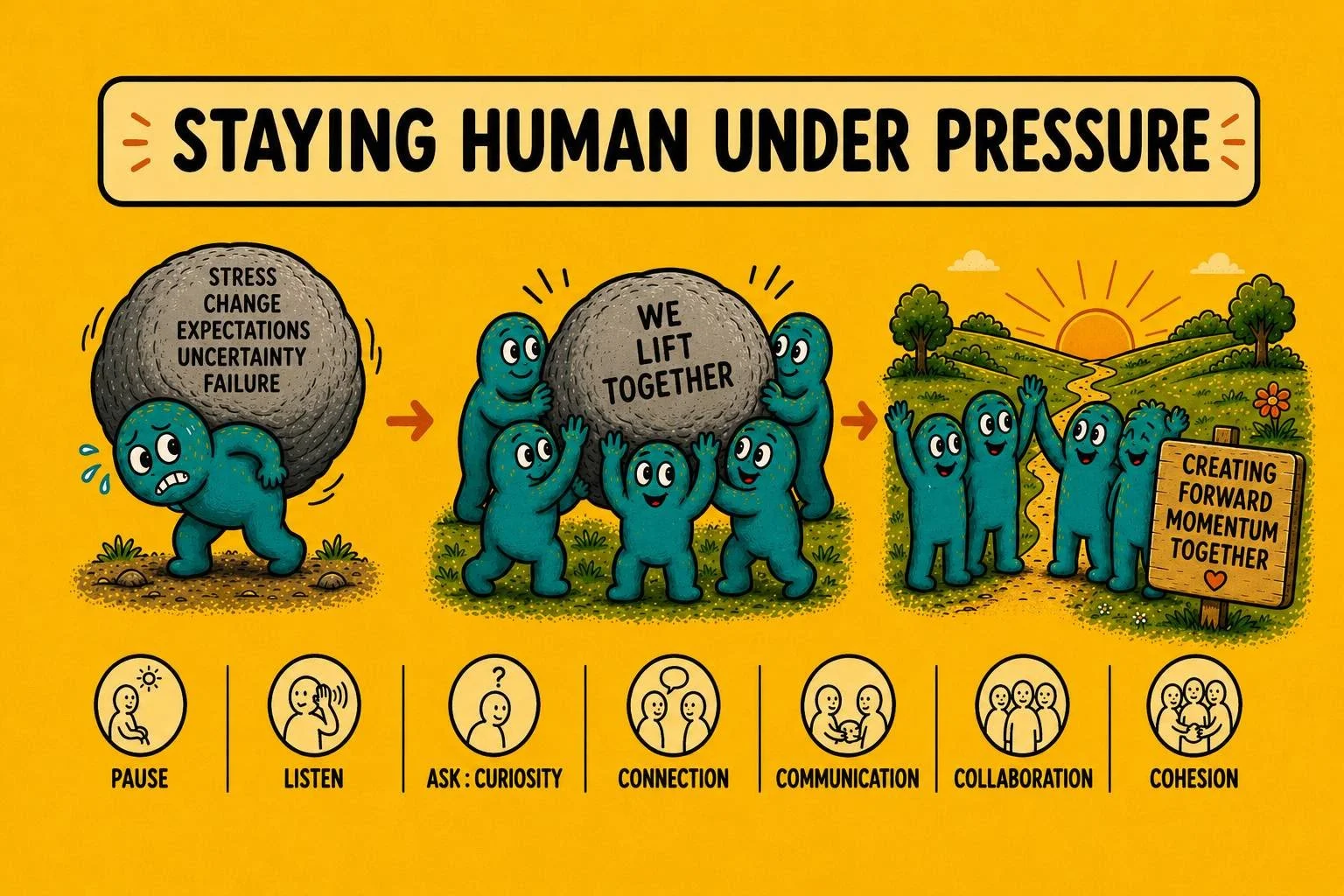
I see you. I want you to know that I care. I can’t fix it for you, but I’m here if you want to talk. Imagine if this were how we met each other in turbulent times.
For a long time, many of us stress-badged. We wore exhaustion like proof that we mattered. Busy meant important. Overwhelmed meant committed.
Now, in many places, we stress-shame. We talk about stress as if it means we’re not resilient enough. We treat overwhelm as a personal failure rather than a human response to sustained pressure.
Neither helps. Both add stigma.
Organizations say it’s OK not to be OK—and to ask for help. That’s how Mental Health Awareness has been implemented in many workplaces, but we’re missing the point.
That framing can still treat mental health as a vulnerability to manage. People hear an unspoken warning: Don’t let this impact performance—instead of the truth: mental health is part of performance.
Worry-load, not just work-load
One of the most surprising discoveries I had while coaching wasn’t that people were burning out because they were working too much.
It was that they were carrying too much uncertainty—often alone.
Uncertainty doesn’t respond to willpower. It changes how the nervous system functions over time. Under sustained pressure, many of us swing between:
Self-criticism (“I should be able to handle this.”)
Forced reassurance (“It’ll be fine.”)
Two common stress responses. Two ways we try to manufacture certainty. And two ways our real needs stay unaddressed.
When silence feels safer (and speaking up feels lonelier)
Sometimes we stay silent—not because we don’t have needs, but because honesty can be met with dismissal, fixing, or forced optimism.
Sometimes we do share how we feel, and a well‑meaning “Don’t worry—you’ve got this” is meant to cheer us on. But being told not to worry doesn’t stop the worry, even when someone believes we can handle it. We have to trust that we can handle it too—and that means we have to talk about it, not just push it down. What was meant as “cheer” can land like: Your worry is inconvenient, or You shouldn’t feel this way, and certainly … You’re on your own.
Uncertainty doesn’t shrink when we’re reassured. It often grows—because now we feel wrong and alone.
Try using my AAA method to open a more attuned conversation:
Acknowledge how they feel: “That makes sense. I’m really glad you told me.”
Accept what’s real: “It’s not easy to accept this situation as it is. Uncertainty is real right now—and so is the FUD (fear, uncertainty, and doubt).”
Ask what they need: “How can I support you? What do you need to be able to work with this uncertainty?”
What it looks like to care together
Staying human under pressure is not about performing clarity. It’s about creating the conditions where people can be honest—without collapsing or compensating.
A simple shared practice:
Pause: create space; come back to the present moment.
Listen: hear to understand; lead with empathy.
Ask (curiosity): replace assumptions with questions.
Connection: build trust by being real.
Communication: speak clearly; listen openly.
Collaboration: work with each other, not around each other.
Cohesion: unite as one; remember what matters.
None of this requires perfection. It does require willingness.
A human next step
If you’re carrying a lot of pressure, uncertainty, and worry, please know:
We are not meant to carry this alone. We lift burdens together and pursue purpose collectively. Our trust that we can figure it out grows stronger when it’s shared. Like the Icelandic saying, Redda thetta—“it will work out”—this isn’t false hope that all will be OK, but a promise that we can figure it out and grow through uncertainty together.
What would change if care were normal—part of our shared operating system—and support were built in long before things become urgent?
PAUSE ON THIS: A call to care (today)
Do one small, real thing—within the next 24 hours:
Name the worry-load: Write the one sentence you keep avoiding (“I’m worried about .”)
Share one piece: Ask one person for 10 minutes: “Can I share something I’m carrying? I don’t need fixing—just listening.”
Make a clear ask: “What I need is ____” (clarity, help prioritizing, a decision, practical support, or simply presence).
Take one uncertainty-reducing step: clarify the next action, schedule the conversation, delegate, or decide.
Pressure is real. Care is a practice. Let's practice staying human under pressure together.